| Tue. July 21, 2026 |
 |
|
||
|
||||
| ||||



Ukraine’s 6 July strike on the Omsk refinery, 2,500 kilometres inside Russia, and the NATO summit in Ankara two days later, where President Trump called a settlement “getting closer than people realize,” look like separate stories — one military, one diplomatic (Kyiv Independent 2026; United24 Media 2026; Al Jazeera 2026a). They are the same story, and it is the story of three failed bets on speed. Russia bet that manoeuvre would force capitulation within weeks; the West bet that sanctions would compress Russia’s economy into submission on a comparable timeline; Washington’s diplomacy now bets that personal engagement among Trump, Putin, and Zelensky can close, within months, a gap four years of war have not. All three assumed a decisive mechanism operating fast, when attrition, institutional adaptation, and credible commitment all run on the timeline of years. What remains, after each bet failed in turn, is a contest over reciprocal cost-imposition — each side trying to outlast the other’s capacity to fund, fuel, and arm itself — and that contest, not any single breakthrough, defines the war’s current phase and explains why an economic war has deepened exactly as negotiation has intensified.
The evidence for the first two failures is stark. Russia’s front, after freezing into positional stalemate by 2024 (Fischer 2025), has since collapsed further into something closer to a rout in slow motion: net territorial gain across the first half of 2026 was just 97 square kilometres, against Ukrainian estimates of nearly 40,000 Russian casualties in June alone — a loss rate per square kilometre roughly nineteen times higher than a year earlier (Al Jazeera 2026b). One might read that stall as tactical exhaustion rather than a structural shift, but the casualty-to-territory ratio argues otherwise: Russia is paying dramatically more per kilometre than it once did, not losing the will to keep paying. The sanctions bet fared no better on its own timeline: Congress approved roughly $175 billion through early 2024 plus a further $60 billion that April (CRFB 2024), yet Russia’s economy did not buckle on that horizon either. Both governments have since redirected coercive energy toward slower, attritional instruments — refineries, substations, drone lines — where the war’s political economy is now actually decided.
That redirection is clearest in energy, where the strikes on both sides do double duty. Classical coercion theory distinguishes denial, which degrades an adversary’s capacity to fight, from punishment, which raises costs on civilians to force a change in policy (Pape 1996); Ukraine’s refinery campaign, having cut roughly a quarter of Russian refining capacity and hit eight of the ten largest plants since March, does both at once (National Security Journal 2026). It denies fuel to Russian forces while visiting shortages on civilians: fuel restrictions now reported across 55 of Russia’s 83 regions, Sevastopol gasoline briefly above 199 rubles a litre against roughly 86 on the wider peninsula, petrol exports banned, fuel imported from India (Moscow Times 2026; National Security Journal 2026). Russia’s campaign against Ukraine’s grid runs the identical dual logic in reverse. Pairing financial exclusion with precision strikes on physical chokepoints compresses a timeline that sanctions theory usually treats as slow and blunt — which is exactly why refining and grid resilience, not territory, are now the more accurate measures of strategic depth.
The same logic drives an industrial contest in drones, which has restructured the economics of the war more than any single weapon system. Ukraine’s annual output rose from roughly 2.2 million units in 2024 to about 4 million in 2025, with capacity now above 8 million across more than 160 manufacturers (National Security Journal 2026; RNBO Ukraine 2026); Ukrainian officials assess Russia is pursuing comparable scale, reportedly targeting over 7 million FPV drones and 7.8 million warheads for 2026, though Russian figures are harder to verify independently (Kyiv Post 2026a). Where conventional warfare concentrated cost in a small number of exquisite platforms, drone warfare distributes it across millions of expendable units priced in the hundreds of dollars — converting the contest from one of platform quality into one of manufacturing tempo, a shift in the underlying economics of combat rather than merely its tactics.
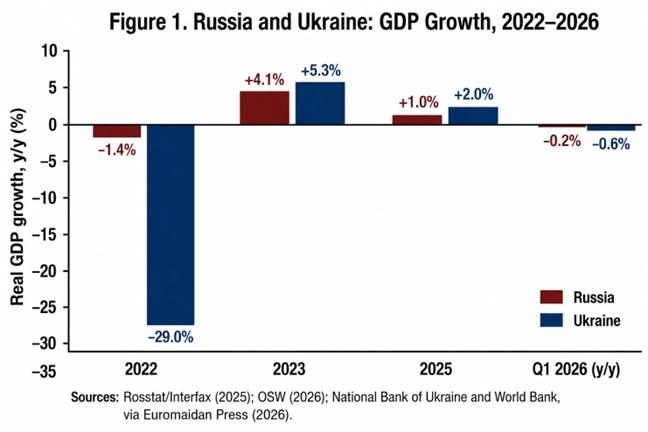
Ukraine and World Bank, via Euromaidan Press (2026).
The financial and military fronts now mirror each other, converging from opposite directions. Sanctions have made Russia arguably the most sanctioned state anywhere, denying it an estimated $500 billion in war-related resources and freezing about 70 percent of its banking-system assets (CSIS 2025), yet its resilience has rested on institutional adaptation, not oil revenue alone, after fifteen years of governing through improvised crisis management (Prokopenko 2023). That resilience is now fraying: growth slowed to roughly 1 percent in 2025, and GDP contracted about 0.2 percent year-on-year in the first quarter of 2026, its first quarterly decline in three years, as energy revenue fell (OSW 2026; Interfax 2025). Ukraine’s resilience has always been externally financed rather than institutionally generated: output collapsed by close to 29 percent in 2022 before rebounding 5.3 percent in 2023 (World Bank 2026), yet growth also turned negative the same quarter as Russia’s, contracting 0.6 percent as the binding constraint shifted from financing toward the capacity to absorb it — power, labour, institutions (Euromaidan Press 2026). Reconstruction needs now approach $588 billion, nearly three times Ukraine’s annual output (World Bank 2026): two economies, resilient by different mechanisms, are short of runway together.
|
Indicator |
Russia |
Ukraine |
|
GDP growth, 2022 |
-1.4% (Rosstat, revised) |
˜-29% (World Bank) |
|
GDP growth, 2023 |
+4.1% (Rosstat, revised) |
+5.3% (World Bank) |
|
GDP growth, 2025 |
+1.0% |
˜+2.0% (IMF) |
|
GDP growth, Q1 2026 (y/y) |
-0.2% |
-0.6% (Natl Bank of Ukraine) |
|
Sanctions / financial exposure |
World's most-sanctioned state; ˜$500bn in war-related resources denied; ˜70% of banking assets frozen |
Recovery financing conditioned on Western political cycles |
|
Energy-infrastructure stress, 2026 |
˜25% of refining capacity hit since March; fuel restrictions reported in 55 of 83 regions |
Sustained Russian strikes on the power grid continue |
|
2026 FPV drone output |
˜7.3M (targeted; Ukrainian military assessment) |
˜8M capacity; 160+ manufacturers |
|
Reconstruction / recovery need |
— |
˜$588 billion over 10 years |
Table 1. Comparative political economy of the war, 2022–2026. Compiled from the sources cited throughout the text and listed in the references below.
The third bet — that personal diplomacy could close the gap within a single presidential term — has fared no better, for the same reason as the first two: it assumes a short timeline for a slow process. Trump’s approach inverts Biden’s in method: his August 2025 summit with Putin in Anchorage produced no signed deal but anchored a peace framework since whittled from a 28-point draft to twenty points, without Moscow’s explicit endorsement (CSIS 2026; ABC News 2025). Where Biden tied support for Kyiv to Russia’s culpability, Trump has recast Washington as an “impartial broker” and pressed Kyiv toward territorial compromise while ruling out NATO membership (CFR 2026; Fischer 2025) — yet the record is not simple retrenchment: at Ankara he welcomed NATO’s €70 billion pledge, offered to help Ukraine build Patriot systems domestically, and described a “highly constructive” call with Putin on ending hostilities (Al Jazeera 2026a; The Hill 2026). What this diplomacy has not resolved is the commitment problem beneath the stalemate: neither side can credibly commit while the other’s capacity to endure remains uncertain.
None of the plausible paths out — a partial settlement freezing the front on Ukraine’s European-financed terms, a collapse back into deeper mutual attrition, or a fracture in Western cohesion that lets Russia consolidate its position — is a fourth bet likely to fare better than the first three; each merely relocates the underlying arithmetic rather than resolving it. The war’s centre of gravity has moved from the Donbas to refineries, drone lines, and ledgers, and any durable outcome will be decided there before it is signed at a summit. What the case ultimately illustrates is broader than Ukraine: between two economically entangled, drone-saturated belligerents, victory becomes less a matter of destroying an opponent’s army than of outlasting its capacity to keep paying for one — and diplomacy’s role, for now, is to manage that arithmetic rather than to settle it.
Vikas Bhardwaj is a scholar of international political economy, holding a Ph.D. and M.Phil. from the Centre for Russian and Central Asian Studies, School of International Studies, Jawaharlal Nehru University (JNU), New Delhi. His work focuses on economic statecraft, sanctions, energy geopolitics, and global economic governance.
He has worked as a researcher with numerous institutions, including the Indian Institute of Public Administration (IIPA), contributing to multiple policy evaluation projects commissioned by the Government of India Ministries. Bhardwaj holds nine academic degrees and has published in international peer-reviewed journals on the Russian economy, geopolitical conflict, and shifting global power dynamics.
References
ABC News. 2025. “Inside the Push for a Russia-Ukraine Peace Deal, from Anchorage to a 28-Point Plan.” December 2025.
Al Jazeera. 2026a. “NATO Pledges €70bn for Ukraine’s 2026 Defence as Trump Hails Peace ‘Progress.’” July 8, 2026.
Al Jazeera. 2026b. “Russia’s Summer Offensive Has Nearly Stalled. What Does This Mean for the War?” July 3, 2026.
Center for Strategic and International Studies (CSIS). 2025. “How Sanctions Have Reshaped Russia’s Future.” February 24, 2025.
Center for Strategic and International Studies (CSIS). 2026. “The Unfinished Plan for Peace in Ukraine.” 2026.
Committee for a Responsible Federal Budget (CRFB). 2024. “Congressionally Approved Ukraine Aid Totals $175 Billion.” May 10, 2024.
Council on Foreign Relations (CFR). 2026. “Here’s How Much Aid the United States Has Sent Ukraine.” Updated 2026.
Euromaidan Press. 2026. “Ukraine’s Economy Posted Its Sharpest Contraction since the Wartime Recovery Began.” June 23, 2026.
Fischer, Sabine. 2025. “‘Everything about Ukraine without Ukraine.’” SWP Comment No. 14/2025. Berlin: Stiftung Wissenschaft und Politik.
The Hill. 2026. “Trump Holds ‘Highly Constructive’ Call with Putin on Ukraine.” July 2026.
Interfax. 2025. “Russian GDP Grows 4.1% in 2024, as in 2023 — Rosstat.”
Kyiv Independent. 2026. “Russia’s Largest Oil Refinery in Flames as Ukraine Strikes Omsk, 2,500 km Away from Border.” July 6, 2026.
Kyiv Post. 2026a. “Russia to Produce Over 7 Million FPV Drones in 2026, Ukrainian Commander Warns.” May 8, 2026.
Moscow Times. 2026. “Gasoline Prices in Annexed Sevastopol Jump 30% in One Week.” July 2, 2026.
National Security Journal. 2026. “Ukraine Is on Track to Build 8 Million Drones This Year — and Russia’s Air Defenses Can’t Keep Up.” June 2026.
OSW Centre for Eastern Studies. 2026. “Russia’s Economy Heads towards Recession.” OSW Commentary, May 2026.
Pape, Robert A. 1996. Bombing to Win: Air Power and Coercion in War. Ithaca, NY: Cornell University Press.
Prokopenko, Alexandra. 2023. “Permanent Crisis Mode: Why Russia’s Economy Has Been So Resilient against Sanctions.” ZOiS Report 4/2023. Berlin: Centre for East European and International Studies.
RNBO Ukraine (National Security and Defense Council of Ukraine). 2026. “Results of Ukraine’s Defense Industry in 2025: FPV Drones.”
United24 Media. 2026. “Ukrainian Drone Strike Halts Russia’s Largest Oil Refinery in Omsk, Reuters Reports.” July 2026.
World Bank. 2026. “Ukraine: Rapid Damage and Needs Assessment (RDNA5).” February 2026.
| Comments in Chronological order (0 total comments) | |
| Report Abuse |
| Contact Us | About Us | Donate | Terms & Conditions |


|
All Rights Reserved. Copyright 2002 - 2026