| Fri. August 14, 2026 |
 |
|
||
|
||||
| ||||



By Dr. Vikas Bhardwaj
Three men who each answer to Washington signed a mutual-defence pact in Mecca on 7 August 2026 that Washington neither drafted nor was asked to countersign. Crown Prince Mohammed bin Salman, President Recep Tayyip Erdogan and Prime Minister Shehbaz Sharif agreed that an armed attack on any one of their states would be treated as an attack on all three (Azhari, Shahid, and Gümrükcü 2026). None of them meant it as a divorce: Saudi Arabia still flies American jets, Turkey still carries a NATO card, Pakistan still calls itself a U.S. security partner. The puzzle is not desertion; it is why entanglement this deep no longer feels sufficient alone.
Call it hedging rather than abandonment. The three governments are stacking new, imperfect layers of deterrence on top of an American relationship none of them is prepared to give up — not replacing Washington, but no longer betting everything on it.
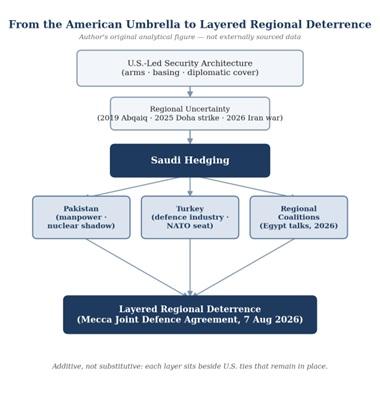
Figure 1. From the American umbrella to layered regional deterrence. Author’s original analytical figure — not externally sourced data.
The old bargain was simple: American arms, bases and diplomatic cover, in exchange for oil and quiescence. It has frayed since at least 2019, when Iranian drone strikes on Saudi Arabia drew little more than mild condemnation from Washington (Chattell 2026). The pattern repeated on 9 September 2025, when Israeli strikes on Hamas leaders in Doha — an attack on allied soil — met no American reprisal (Al Jazeera 2026; Ashtakala, Horschig, and Schiff 2025). Riyadh and Islamabad signed their bilateral Strategic Mutual Defense Agreement eight days later (Ministry of Foreign Affairs, Pakistan 2025). None of this means Washington is leaving; its bases remain in place. What has eroded is quieter — the assumption that a guarantee arrives automatically once tested.
What gave Riyadh's hedging real urgency was the war Israel and the United States opened against Iran on 28 February 2026 (Al Jazeera 2026). Houthi and Iranian-aligned strikes have hit Saudi Arabia repeatedly since, along with five other Gulf states, unsettling oil exports and the financing behind Vision 2030 (Al Jazeera 2026). "A hedge against over-dependence on great powers" is how Brookings' Joshua White (2025) described the September pact with Pakistan — more precise than "alliance," less dramatic than some contemporary commentary. Riyadh is not abandoning the relationship that still supplies its F-15s and THAAD batteries (Ashtakala, Horschig, and Schiff 2025); it is building redundancy underneath it, so no single partner's hesitation determines the kingdom's exposure.
Turkey is the harder case, and Chatham House was blunt about why: unlike Saudi Arabia, Ankara already has a formal American guarantee through NATO, so a new pact "would not make NATO member Turkey better defended" (Chattell 2026). A Pakistani nuclear umbrella reaching Turkey is harder still to credit — Islamabad's missiles cover Iran and, at their outer edge, Russia's Rostov-on-Don, nothing resembling Turkey's own threat map (Chattell 2026). What the pact offers instead is leverage, inside NATO and beyond it, plus a paying customer for a defence-export sector that reportedly shipped over $10 billion abroad in 2025 — Baykar's Akinci drones chief among them, partly assembled on Saudi soil since 2023 (Türkiye Exporters' Assembly 2026). Erdogan may simply be monetising a security he has already secured elsewhere.
The asset Pakistan brings is one Riyadh cannot purchase: roughly 660,000 active troops and, more consequentially, nuclear weapons (International Institute for Strategic Studies 2026). Pakistan's defence minister suggested in September 2025 that this capability could extend to protecting Saudi Arabia — a claim Pakistani commentators almost immediately downgraded to symbolic solidarity (White 2025). CSIS's reading is unambiguous: the pact "does not establish extended nuclear deterrence," since Pakistani doctrine was built to deter India, not defend Arabian oil terminals (Ashtakala, Horschig, and Schiff 2025). That walk-back matters more than the original claim did. What Pakistan offers with more confidence is conventional depth, recent combat experience against India, and a defence budget up eleven percent in 2025 on fresh Chinese orders (Liang et al. 2026) — itself a hedge against Beijing.
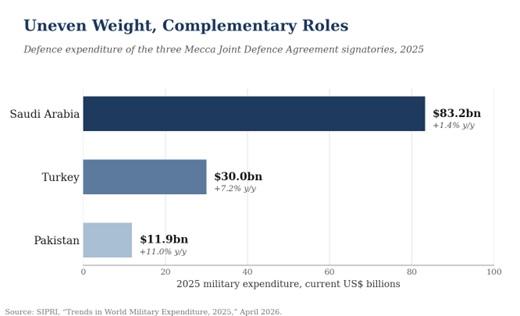
Laid side by side, the three states are not remotely equal, and the pact does not pretend otherwise. Saudi Arabia supplies capital and geography: its 2025 defence budget of $83.2 billion is nearly triple Turkey's and almost seven times Pakistan's (Liang et al. 2026). Turkey supplies the only genuinely indigenous defence-industrial base of the three, plus a NATO seat few adversaries can casually discount. Pakistan supplies manpower, combat experience, and the ambiguous shadow — nothing firmer — of nuclear weapons. None could sustain today's deterrent posture alone. What makes the arrangement more than theatre is that their assets are complementary rather than duplicated.
Calling this "NATO 2.0" is tempting, and wrong. Article 5 sits atop seventy years of integrated commands and — carefully unstated but structurally real — American nuclear guarantees (North Atlantic Treaty Organization 1949). The Mecca text borrows collective-defence language, not yet the machinery beneath it; the 2025 bilateral pact spoke of aggression, a broader trigger than NATO's armed attack (Ashtakala, Horschig, and Schiff 2025). A Turkish official called the new pact "purely defensive in nature," open to other states and replacing no existing commitment (NewsCord 2026). Alliance theorists have long identified a trade-off between two risks facing any junior partner: abandonment by its patron, or entrapment in a patron's war (Snyder 1984). Vague collective-defence language of the Mecca kind manages that trade-off by reassuring without quite committing.
Table 1. NATO versus the Mecca Joint Defence Agreement
|
Dimension |
NATO |
Mecca Joint Defence Agreement |
|
Membership |
32 states, transatlantic |
3 states — Saudi Arabia, Türkiye, Pakistan |
|
Core guarantor |
Collective, U.S.-anchored |
No single guarantor; regional powers |
|
Legal trigger |
“Armed attack” (Article 5) |
“Aggression” — broader, undefined threshold |
|
Command structure |
Permanent integrated command (SACEUR) |
None disclosed |
|
Military integration |
Deep; standing exercises since 1949 |
Nascent; industrial ties precede integration |
|
Nuclear dimension |
Formal U.S./UK/French guarantees |
Explicitly disclaimed by Islamabad and analysts |
|
Geographic scope |
Euro-Atlantic |
West/South Asian; possible Egyptian accession |
|
Stated purpose |
Collective defence against armed attack |
“Purely defensive,” not directed at any actor |
Source: Author's compilation from North Atlantic Treaty Organization (1949); Ashtakala, Horschig, and Schiff (2025); and Shankar (2026).
The comparison, in the end, is one of depth rather than ambition.
No single adversary explains the pact, and Iran's own reaction has been more divided than alarmed. Iranian and allied forces have struck Gulf states repeatedly since the February war began (Al Jazeera 2026); Israel's operations in Lebanon and Syria unsettle Ankara nearly as much as Tehran (Al Jazeera 2026); Red Sea shipping has been disrupted for the better part of a year. Yet one Iranian parliamentarian dismissed the pact outright — "a paper agreement… will not bring them security," urging Riyadh to stop relying on others for protection — while other Iranian voices treated it as unremarkable (Uniyal 2026). That split suggests Tehran functions less as this architecture's target than as one of several catalysts behind it.
Strip away the theatre and what remains is additive, not substitutive. Riyadh's American arms purchases continue at scale; Ankara's NATO membership is untouched; Islamabad still calls Washington a partner, however strained that relationship has been since 2018. The Atlantic Council (2026) read the pact as "an inflection point in the emerging multipolar order" — a description that risks overstating an agreement three governments have gone out of their way to call defensive and non-exclusive. "Plus, not replacement" is the duller, more defensible formulation — and close to what Washington has quietly wanted from its regional partners for years: allies who shoulder more of their own deterring.
Three rival readings deserve a hearing. That this is an anti-Iran bloc sits awkwardly against Tehran's own divided response — hardly the posture of a state that feels newly encircled. That it is an embryonic "Islamic NATO" overstates a framework its own architects insist is not comparable to NATO, and one Egypt has reportedly discussed joining without yet signing anything (Shankar 2026). That it is merely symbolic is the hardest claim to dismiss — analysts have cautioned against assuming operational effect simply because the text was signed (Shankar 2026) — though symbolism that redirects defence-industrial investment reshapes incentives before anyone is forced to test it.
Four paths run from here. The pact could institutionalise, through joint exercises and shared production lines reportedly already under discussion. It could stay largely symbolic, a signal with little operational substance beneath it. A serious attack on any member's territory would force the sharpest test: whether "an attack on one" produces troops, or only statements. Or it could widen, with Egypt and others eventually attaching themselves to a framework its architects call open-ended (Shankar 2026). Which prevails will say more about the pact's substance than the Mecca text itself ever could.
The temptation is to read Mecca as proof that American power is retreating from West Asia. The more accurate version is also the more consequential one: Gulf and South Asian states no longer assume that proximity to Washington is protection enough by itself, so they are building alternatives beside it, not instead of it. Three governments with sharply different capabilities and fears have judged it worth formalising a promise none yet fully knows how to keep. What emerged from Mecca is not a post-American order. It is a post-exclusive-American one.
Vikas Bhardwaj is a scholar of international political economy, holding a Ph.D. and M.Phil. from the Centre for Russian and Central Asian Studies, School of International Studies, Jawaharlal Nehru University (JNU), New Delhi. His work focuses on economic statecraft, sanctions, energy geopolitics, and global economic governance.
He has worked as a researcher with numerous institutions, including the Indian Institute of Public Administration (IIPA), contributing to multiple policy evaluation projects commissioned by the Government of India Ministries. Bhardwaj holds nine academic degrees and has published in international peer-reviewed journals on the Russian economy, geopolitical conflict, and shifting global power dynamics.
References
Al Jazeera. 2026. "Saudi Arabia, Pakistan and Türkiye Sign Defence Deal Amid Regional Turmoil." August 7, 2026.
Ashtakala, Diya, Doreen Horschig, and Bailey Schiff. 2025. "Could the Pakistani-Saudi Defense Pact Be the First Step Toward a NATO-Style Alliance?" CSIS Critical Questions. Center for Strategic and International Studies, October 6, 2025.
Atlantic Council. 2026. "Why Saudi Arabia, Pakistan, and Turkey Just Signed a Defense Pact." MENASource, August 7, 2026.
Azhari, Timour, Ariba Shahid, and Tuvan Gümrükcü. 2026. "Saudi Arabia, Turkey and Pakistan Sign Joint Defence Deal Amid Regional Turmoil." Reuters, August 7, 2026.
Chattell, Tim. 2026. "Talk of a Turkish Military Alliance with Saudi Arabia and Pakistan Reflects Ankara's Opportunistic 'Hedging' Strategy." Chatham House, January 30, 2026.
International Institute for Strategic Studies. 2026. The Military Balance 2026. London: IISS.
Liang, Xiao, Lorenzo Scarazzato, Diego Lopes da Silva, and Nan Tian. 2026. "Trends in World Military Expenditure, 2025." SIPRI Fact Sheet. Stockholm: Stockholm International Peace Research Institute, April 2026.
Ministry of Foreign Affairs, Pakistan. 2025. "Joint Statement on the State Visit of Prime Minister of the Islamic Republic of Pakistan Muhammad Shehbaz Sharif to the Kingdom of Saudi Arabia." September 17, 2025.
NewsCord. 2026. "Saudi Arabia, Turkey And Pakistan Sign Mecca Joint Defence Agreement: How 29 Outlets Framed It." August 7, 2026.
North Atlantic Treaty Organization. 1949. The North Atlantic Treaty. Washington, DC, April 4, 1949.
Shankar, Priyanka. 2026. "Türkiye, Saudi Arabia, Pakistan Sign Joint Defence Agreement: What's in It?" Al Jazeera, August 7, 2026.
Snyder, Glenn H. 1984. "The Security Dilemma in Alliance Politics." World Politics 36 (4): 461–95.
Türkiye Exporters' Assembly. 2026. Defence and Aerospace Sector Export Report, 2025. Ankara: TIM.
Uniyal, Vijeta. 2026. "'Mecca Agreement': Saudi Arabia, Turkey and Pakistan Sign Joint Military Pact." Legal Insurrection, August 7, 2026.
White, Joshua T. 2025. "The Signal and Substance of the New Saudi-Pakistan Defense Pact." Brookings, September 24, 2025.
| Comments in Chronological order (0 total comments) | |
| Report Abuse |
| Contact Us | About Us | Donate | Terms & Conditions |


|
All Rights Reserved. Copyright 2002 - 2026