| Tue. March 03, 2026 | |

|
|
|
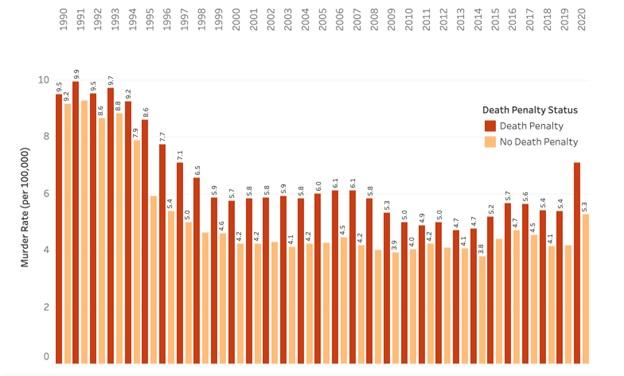
 Abstract This paper aims to demonstrate why the death penalty is ineffective in terms of its deterrence and economic effects. In addition, it explores the ethical complications that the death penalty presents, highlighting its conflict with the categorical imperative in Kantianism, modern utilitarian ethics and the general field of ethics. I have synthesized previous research to further my argument and conducted novel research on the utilitarian effects of capital punishment and a survey of retentionist countries and their correlation discrimination. I researched how the death penalty is correlated with less happiness in death penalty retentionist countries, which may contribute towards a culture in which the rate of crime, such as murder, can proliferate. I also researched the high correlation with discrimination and the death penalty but in a more global context. These findings corroborate previous research on the relationship between happiness, arbitrariness, and the death penalty. Overall, evidence indicates that the death penalty is fundamentally flawed, suggesting its replacement with life imprisonment without the possibility of parole. Introduction Many scholars have defended capital punishment, favoring retributive justice. For context, the origins of the death penalty may date to Ancient Mesopotamia, where the Code of Ur-Nammu, the first set of known written laws, included this punishment.[1] Although only some of the Code of Ur-Nammu has survived, it provides the legal foundation for the death penalty. Throughout history, the death penalty was used for even the most minor of crimes. In recent times, the death penalty has been used for severe crimes in general. Nonetheless, its use has been waning dramatically.[2] While many scholars staunchly defend the death penalty because it embodies retributive justice, research suggests that capital punishment should be abolished in the US because it is ineffective at deterring crime, lacks economic feasibility, and suffers from several ethical issues. Deterrence: Capital punishment is not an effective deterrent for murder rates. A deterrent in this context is a method of punishment that disincentives murder and lowers murder rates in US states. Hans Zeisel, a former professor at the University of Chicago, explains the ineffectiveness of the death penalty in his paper The Deterrent Effect of the Death Penalty: Facts v. Faiths. He portrayed that U.S. states without the death penalty usually experienced lower homicide rates.[3] Although his comparison was conducted on data collected from 1920–1958 and included just fifteen states, it provides preliminary evidence that the death penalty did not produce a deterrent effect. More contemporary research supports Zeisel’s findings. According to data provided by the Death Penalty Information Center, US States without capital punishment have a lower murder rate on average compared to States with the death penalty.[4] If capital punishment was an effective punishment, it would lower the murder rate. However, according to this data, States with the death penalty have an average murder rate higher than those without. Therefore, capital punishment is not an effective deterrent. A graph is provided to show this finding from the Death Penalty Information Center (see fig.1).
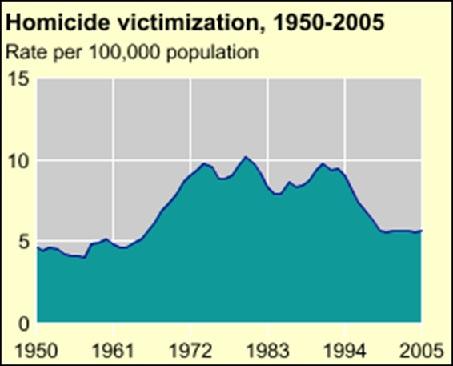
Figure 1: Comparison of Murder Rates from States with and Without the Death Penalty from 1990–2020[5] To better assess whether the death penalty has a deterrence effect at the national level, I investigated whether the nationwide ban of the death penalty from 1972 to 1976 following Furman v. Georgia (1972) influenced homicide rates. From 1972 to 1976, the homicide rate stayed relatively high from around 9 to 10 homicide victims per 100,000 residents. From 1950 to around 1961 the homicide rate stayed relatively low at around five victims per 100,000 residents. It climbed up to around 10 homicide victims just before the Furman v. Georgia. Then, even after the death penalty was reintroduced in 1976, the homicide rate remained around eight to ten victims per 100,000 population. Afterwards, near the turn of the century, the homicide rate plummeted to around five victims per 100,000. In other words, the death penalty does not seem to be correlated to deterring crime. Even after the death penalty was reintroduced, for nearly twenty years the homicide rate remained around the same magnitude. The homicide rate appears to have fallen as a result of changing policies that resulted in mass incarceration, preventing people with a history of criminal behavior from committing more serious offenses in the future. This connection between mass incarceration and crime reduction parallels the broken windows theory, in which visible disorder can result in law-abiding citizens fleeing from public places, leaving behind a high concentration of lawbreakers and creating more opportunities for more severe crime.[6] The logic follows that if minor crimes are policed more effectively and if repeat offenders are incarcerated rather than left alone in situations in which they may escalate to more severe crimes, public spaces are more likely to be occupied by law-abiding citizens, fostering an environment less tolerant of crime. However, the poor track record of safety and human rights protections in prisons may explain why there is a high crime recidivism rate within five years after release. A more appropriate policy may champion restorative justice to lower crime recidivism rates.[7]
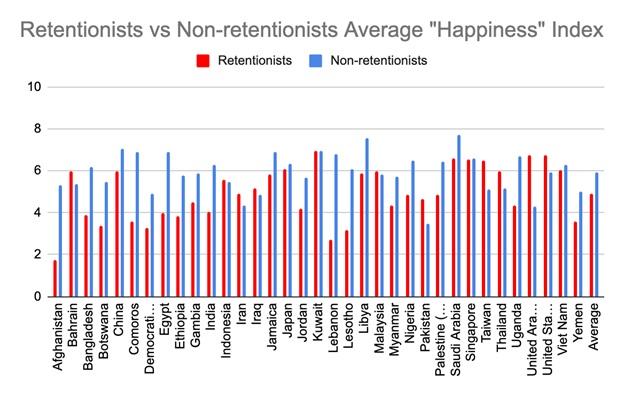
Figure 2: Graph of Homicide Victimization per 100,000 Population in the US[8] Economics The death penalty is economically impractical. Many U.S. states have concluded that the death penalty is more expensive than life imprisonment. A significant example by Amnesty International reveals that a system with the death penalty in California costs “$137 million per year” while it would be “11.5 million” without capital punishment.[9] Additionally, according to the Death Penalty Information Center, the death penalty is more expensive than a system that uses life sentences without the possibility of parole as an alternative.[10] There are several reasons why the death penalty is expensive. First, death penalty trials are longer than life imprisonment trials. Death penalty trials could involve up to two phases. The first phase is to decide whether the defendant is innocent or guilty of their crime or crimes. The second is to determine whether capital punishment is appropriate given any aggravating or mitigating factors. As a result, prosecuting attorneys may spend more time to collect evidence and on cases. Second, these lawyers often spend more time selecting the jury in capital punishment cases and are thus paid more generously in their salary. Therefore, capital punishment is not economically practical because it has been proven not to be an effective deterrent, and it costs more than a life sentence. Modern Utilitarianism While capital punishment is impractical from a deterrence and economic standpoint, it also lacks cohesion with utilitarian ethics. In A Fragment on Government Jeremy Bentham states that utilitarianism is based on a foundational principle: “It is the greatest happiness of the greatest number that is the measure of right and wrong.”[11] Utilitarianism is more nuanced than this “greatest happiness principle.” However, this quote is significant because it explains that the death penalty would be unethical if it did not contribute to the majority's happiness. Moreover, a research paper by Maarten Berg, a law lecturer at Leiden University discusses the death penalty from a utilitarian perspective. Research shows that countries without the death penalty tend to have a higher average happiness index than countries with this punishment using data from the “World Database of Happiness.”[12] This research indicates that countries tend to be happier without the death penalty. It also suggests that the death penalty is not compatible with utilitarianism because states experience less happiness on average, implying that the death penalty would be considered ethical according to utilitarianism. Some might ask whether the population in some countries are happier with the death penalty than in some countries without the death penalty. This may be true. However, countries generally tend to be happier without the death penalty. I examined whether the death penalty aligns with or contradicts modern utilitarianism using a different dataset. The World Happiness Report provides data that establishes the connection between average happiness and the presence or absence of a death penalty across countries. Retentionist countries or territories are those that have executed an inmate within the last ten years, while non-retentionists have not. While average happiness data has been analyzed at least once before in relation to the death penalty, applying data from the World Happiness Report on capital punishment does not appear to have been published before in English. On a scale from one to ten, the average life evaluation (or “happiness”) index is 4.9 for retentionists, compared to 5.8 for non-retentionists. This metric accounts for important factors that determine the average happiness within a country, including social support, freedom, and generosity of residents.[13] According to 2024 data from the World Happiness Report,[14] there is almost a 10% decrease in life evaluation for countries with the death penalty compared to those without. Many countries with the death penalty experience less happiness on average according to this metric, which suggests that the death penalty is unethical through a modern utilitarianism perspective. Exploring any connection between the death penalty and happiness is crucial because it may suggest the death penalty creates a negative environment in which violent crime, like murder, can thrive. Figure 3 shows the average life evaluation index of all death penalty countries that have data compared with some unnamed countries that lack this punishment, both in alphabetical order. A link to a comparison of the extended version can be seen here.
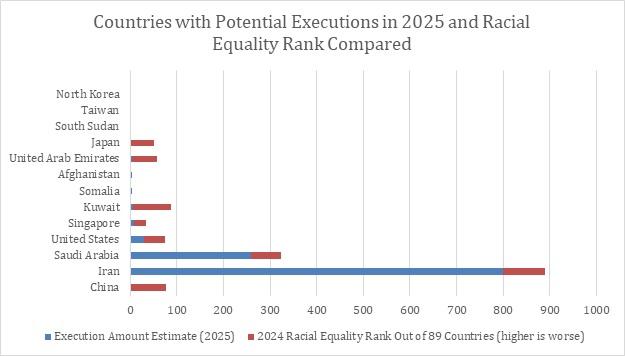
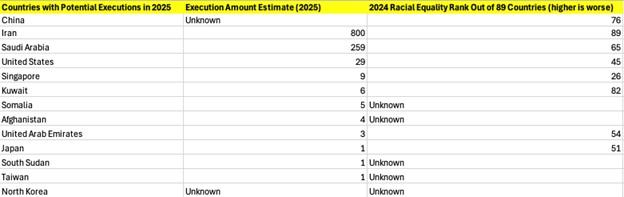
Figure 3: Comparison of the Life Evaluation Index of Retentionist States Against Some Non-retentionists States in Alphabetical Order According to the 2024 World Happiness Report Kantianism The death penalty is not just put under scrutiny by utilitarianism but also by Kantianism. In Kantian ethics or Kantianism, one fundamental axiom is for one to pursue their “duty.” What determines one's duty, according to Immanuel Kant is the categorical imperative. In The Groundwork of the Metaphysics of Morals, Kant defines the categorical imperative as to act only “according to that maxim whereby you can at the same time will that it should become a universal law.”[15] Kant defines two types of categorical imperatives. He describes the categorical imperative as the principle of universalization, in which one considers whether an action could be applied as universal law and still remain justified. Kantianism has been used to defend rights as they are considered universal. In a modern context, this should include fundamental human rights, such as a person's right to life and security. Capital punishment can deprive death row inmates of their right to life. This can run counter to the duty of government, which is to protect fundamental rights, including human rights, because it goes against one of the universal rights: the right to life. This is why life sentences may be more ethical than the death penalty for even the most severe cases of homicide. Nonetheless, many Kantian ethicists who support the death penalty do not recognize the right to life as a legitimate right. However, this should be reconsidered as the UN Declaration of Human Rights considers the right to life and fundamental human rights as legitimate rights everyone should be entitled to. In addition, many countries throughout the world acknowledge the right to life and how it interferes with the death penalty. For example, Title 1 of the EU Charter recognizes the right to life and bans the death penalty from being used. This has been a historical God-given right from the time of John Locke to the present day. In recent times, the right to life is becoming more recognized as a legitimate right. As such, the right to life should be considered a fundamental right under Kantianism, considering the general trend of the world. However, some scholars, including Immanuel Kant, have advocated for the death penalty. It has been documented that Immanuel Kant was a staunch defender of the death penalty. Kant is famous for defending retributive justice among more contemporary philosophers. According to Benjamin Yost, a Professor of Philosophy at Cornell University Kant defended the death penalty because he believed that convicts of murder should be equally punished for the crime of which they were convicted.[16] Additionally, according to Yost, Kant argued that it was dishonorable for a convict of murder to be imprisoned for a non-death penalty sentence instead of being killed, and a reasonable convict would choose death because it is more honorable.[17] While these seem to be valid arguments, the categorical imperative provides a framework for evaluating whether this punishment is truly ethical. From this perspective, the government should respect fundamental human rights, such as the right to life. Protecting the rights of convicts should be done before any retributive justice is applied, which means that the execution cannot be morally justified. General Ethics In addition to the death penalty being considered unethical in utilitarianism and Kantianism, it violates the ethical principle of fairness. The death penalty disproportionately affects people of color (POC). The NACDL argues that POC disproportionately receive the death penalty: “The death row population is over 41% Black, even though Black people make up about 13% of the U.S. population.”[18] In other words, POC constitute a large percentage of those who are incarcerated on death row, even though they make up a small percentage of the total American population. Also, an Oklahoma study found two interesting findings. One is that homicide cases in which the victim is white or of a female of a minority, the charged defendant is significantly more likely to receive the death penalty if the defendant is non-white in the US state of Oklahoma.[19] On the other hand, in the same state, white defendants who have allegedly murdered a member of an ethnic or racial minority is much less likely to receive the death penalty.[20] Similar findings were discovered in a 2016 study conducted in the US state of Washington. According to Beckett and Evans, Black Americans were an estimated four times more likely to be convicted of the death penalty by jurors.[21] The reason for these racial disparities may be due to the deep-rooted, institutionalized and multigenerational racism that exists in many states in the South,[22] where the death penalty is most actively used. Additionally, people of color generally earn less than their white counterparts, making them less able to afford private legal representation. It should be noted that public defenders are overworked and are not paid close to what private lawyers earn.[23] This disparity in legal representation may help explain why people of color are disproportionately sentenced to death. In a worldwide application, the death penalty may be prone to the impact of racism. According to 2024 racial equity rankings, some of the most racist countries retain the death penalty, including Iran, Belarus, and Myanmar.[24] In Myanmar, perhaps the most well-known example of discrimination has occurred during the recent Rohingya Genocide. In Iran, the Kurds have been known to be a discriminated minority. Although they make an estimated 8.4% to 13.0% of the entire population, the Kurdish people have represented more than half of the inmates executed for their affiliation with banned political and armed groups.[25] Additionally, the Baluch are another minority in Iran that make up an estimated two to six percent of the population but have comprised an estimated 11% of Iran executions in 2024, 20% of Iran executions in 2023, and 30% of Iran executions in 2022.[26] Considering the longstanding racism in Iran against the Baluch and Kurd minorities,[27] it is unfortunate that the Kurds and Baluch have borne a significant part of Iranian executions even though they are relatively small minorities in Iran. Other countries that have high amounts of racism are also some of the top executioners of the death penalty. Figure 4 shows that countries that retain the death penalty, including countries with a high sharing of capital punishment deaths, generally share in common a high level of racial inequality. This graph uses data from World Population Review and the Cornell Center for Death Penalty Worldwide (as of August 28, 2025). Death penalty countries, according to data that I have made, have mostly been ranking in the bottom half of the racial equality charts, including America. The general trend is that countries that use the death penalty may also experience a high amount of racism, meaning that the death penalty may be used as another instrument of unfairness rather than a instrument of justice. In other words, using the death penalty, especially in countries that face a high level of racism, seems imprudent and can result in more racial discrimination compared to if it was banned.
Figure 4: Countries with Potential Executions Compared with Their Racial Equality (Some Countries have Unknown Values and Are Not Shown) Conclusion The death penalty is deeply flawed. Research suggests that the death penalty is not an effective deterrent to crime, nor is it cost-effective, with the legal process frequently costing more than life imprisonment. Moreover, capital punishment raises significant ethical issues. It conflicts with many aspects of utilitarianism and Kantianism, as well as violating the general principle of fairness. Should capital punishment be abolished, many countries would likely maintain higher levels of satisfaction, reduce systemic racism within legal systems and foster a more humane society. A world where the death penalty is abolished represents progress and strives for the dignity of all citizens. Appendix: Figure 4 Table:
Acknowledgements: I acknowledge Professor Kathryn Miele for her advice in shaping the approach that I have undertaken in my paper. I also would like to acknowledge that I have used Elicit AI to find research articles for this paper. Additionally, I acknowledge that I have used Zeno AI assistant for compiling data presented in this research paper and potentially other AI resources for planning this paper.
[1] Martha T. Roth, Law Collections from Mesopotamia and Asia Minor, 2nd ed. (Atlanta: Scholars Press, 1995), 17–21.\ [2] United Nations Human Rights Office of the High Commissioner, “Death Penalty Incompatible with Right to Life,” United Nations Human Rights Office of the High Commissioner, January 31, 2024, https://www.ohchr.org/en/stories/2024/01/death-penalty-incompatible-right-life (accessed December 4, 2024), paragraph 5. [3] Hans Zeisel, “The Deterrent Effect of the Death Penalty: Facts v. Faiths,” The Supreme Court Review (1976): 317–343, https://www.jstor.org/stable/3108765, 323. [4] Death Penalty Information Center, "Murder Rate of Death Penalty States Compared to Non-Death Penalty States," Death Penalty Information Center, https://deathpenaltyinfo.org/facts-and-research/murder-rates/murder-rate-of-death-penalty-states-compared-to-non-death-penalty-states (accessed December 23, 2024). [5] Death Penalty Information Center, "Murder Rate of Death Penalty States." [6] Sage, “Wilson, James Q., and George L. Kelling: Broken Windows Theory,” Sage, https://sk.sagepub.com/ency/edvol/criminologicaltheory/chpt/wilson-james-q-george-l-kelling-broken-windows#_=_. [7] Casper Lötter, “Gentle Justice Reduces Recidivism and Incarceration: Can South Africa Benefit from the Finnish Experience?,” [8] James Alan Fox and Marianne W. Zawitz, “Homicide Trends in the United States,” Bureau of Justice Statistics, https://bjs.ojp.gov/content/pub/pdf/htius.pdf. [9] Amnesty International USA, “Death Penalty Cost,” Amnesty International USA, June 26, 2023, https://www.amnestyusa.org/issues/death-penalty/death-penalty-facts/death-penalty-cost/ (accessed December 7, 2024). [10] Death Penalty Information Center, “Costs: Studies Consistently Find that the Death Penalty is More Expensive than Alternative Punishments,” Death Penalty Information Center https://deathpenaltyinfo.org/policy-issues/policy/costs. [11] Jeremy Bentham, A Fragment on Government (Cambridge: Cambridge University Press, 1988), 1. [12] 144 [13] World Happiness Report, “FAQ,” accessed January 3, 2025, https://worldhappiness.report/faq/#:~:text=The sub-bars in the,each country than in Dystopia. [14] John F. Helliwell et al., eds., World Happiness Report 2024 (University of Oxford: Wellbeing Research Centre, 2024). [15] Immanuel Kant, Groundwork of the Metaphysics of Morals, trans. James W. Ellington, 3rd ed. (Indianapolis: Hackett, 1993), 30. [16] Benjamin S. Yost, “Kant’s Justification of the Death Penalty Reconsidered,” Kantian Review 15, no. 2 (2010): 2, https://philpapers.org/archive/YOSKJO.pdf. [17] Yost, “Kant’s Justification,” 15. [18] National Association of Criminal Defense Lawyers, “Race and the Death Penalty,” NACDL, December 7, 2022, https://www.nacdl.org/Content/Race-and-the-Death-Penalty (accessed December 7, 2024), paragraph 1. [19] Glenn L. Pierce, Michael L. Radelet, and Susan Sharp, “Race and Death Sentencing for Oklahoma Homicides Committed Between 1990 and 2012,” Journal of Law and Criminology 107, no. 4 (2017): 750, https://scholarlycommons.law.northwestern.edu/cgi/viewcontent.cgi?referer=&httpsredir=1&article=7615&context=jclc. [20] Pierce, Radelet, and Sharp, “Race and Death Sentencing for Oklahoma Homicides Committed Between 1990 and 2012,” 750. [21] Katherine Beckett and Heather Evans, “Race, Death, and Justice: Capital Sentencing in Washington State, 1981-2014,” Columbia Journal of Race and Law 6, no. 2 (2016): 77, https://heinonline.org/HOL/Page?collection=journals&handle=hein.journals/cjoral6&id=78&men_tab=srchresults. [22] Kiana Cox, "Racial Discrimination Shapes How Black Americans View Their Progress and U.S. Institutions," Pew Research Center, June 15, 2024, 2, https://www.pewresearch.org/race-and-ethnicity/2024/06/15/racial-discrimination-shapes-how-black-americans-view-their-progress-and-u-s-institutions-2/#:~:text=By region,of Black adults experience this. [23] S. Richardson and P. A. Goff, "Implicit Racial Bias in Public Defender Triage," Yale Law Journal 122, no. 9 (March 1, 2013): 2631, 2633. [24] “Most Racist Countries 2025,” World Population Review, accessed August 28, 2019, https://worldpopulationreview.com/country-rankings/most-racist-countries. [25] Nina Motazedi, “Iran Sees 75% Increase in Executions During First Four Months of 2025 over 2024,” last modified May 12, 2025, https://deathpenaltyinfo.org/iran-sees-75-increase-in-executions-during-first-four-months-of-2025-over-2024. [26] “Execution of Ethnic Minorities in Iran in 2024,” Iran Human Rights, last modified February 26, 2025, https://www.iranhr.net/en/articles/7376/ [27] Barzoo Eliassi, “Minoritized Communities in Iran: The Struggle for Unconditional Equality,” Iranian Studies 57, no. 2 (2024): 303–9. https://doi.org/10.1017/irn.2024.6.
Bibliography Amnesty International USA. "Death Penalty Cost." Amnesty International USA, June 26, 2023. https://www.amnestyusa.org/issues/death-penalty/death-penalty-facts/death-penalty-cost/#:~:text=In Maryland death penalty cases,million for a single case.&text=In California the current system,system without the death penalty. Beckett, Katherine and Heather Evans. “Race, Death, and Justice: Capital Sentencing in Washington State, 1981-2014.” Columbia Journal of Race and Law 6, no. 2 (2016): 77. https://heinonline.org/HOL/Page?collection=journals&handle=hein.journals/cjoral6&id=78&men_tab=srchresults. Bentham, Jeremy. A Fragment on Government. Cambridge: Cambridge University Press, 1988. Cox, Kiana. "Racial Discrimination Shapes How Black Americans View Their Progress and U.S. Institutions." Race & Ethnicity, Pew Research Center, June 15, 2024. https://www.pewresearch.org/race-and-ethnicity/2024/06/15/racial-discrimination-shapes-how-black-americans-view-their-progress-and-u-s-institutions-2/. Death Penalty Information Center. “Costs: Studies consistently Find That the Death Penalty is More Expensive Than Alternative Punishments.” Accessed August 18, 2025. https://deathpenaltyinfo.org/policy-issues/policy/costs. Death Penalty Information Center. "Murder Rate of Death Penalty States Compared to Non-Death Penalty States." https://deathpenaltyinfo.org/facts-and-research/murder-rates/murder-rate-of-death-penalty-states-compared-to-non-death-penalty-states (accessed December 26, 2024).
|
|



| Contact Us | About Us | Donate | Terms & Conditions |


|
All Rights Reserved. Copyright 2002 - 2026